I woke up this morning and realized that today is Canadian Thanksgiving. Without going into the atrocities from which this holiday derives its name—though never forgetting them—I choose to settle my gratitude on the reciprocal side of giving: receiving.
To receive is truly an art—giving is much easier, I think. Receiving requires steady and generous practice through all the discomfort of unworthiness that may arise, or fear of being unable to give back equally. But equal exchange isn’t true reciprocity; it’s responsibility that borders on obligation and how many of us have learned giving and taking works. But this “all things equal” approach makes receiving forced and effortful when it could be soft and allowing of whatever gifts flow our way from the natural world and the people who care about us.
I think we can all attest to the discomfort that arises alongside the joy when someone spontaneously pays for dinner or gives us flowers. Thank you doesn’t always seem sufficient, and we might feel indebted to the person, to pay them back on equal terms. And I wonder, how does that serve any kind of greater good?
During a walk this morning, a friend asked me, “what do you think reciprocity is?” The words flew out of my mouth before I’d properly considered them: “it’s thank you and you’re welcome”, I said. He responded, “that’s it? I was prepared for a bit more analysis.” Maybe I could unpack reciprocity, dissect it down to semantic debris, but we do that a lot, don’t we? Scrutinize words to death as a way to express opinions and bend objective truth until it packs nice and tidy into our individual worldviews.
Today, I am in a simple mood, and so thank you and you’re welcome sufficed. But it’s actually not that simple, because even the act of giving is looked at with suspicious eyes these days. More than once, I have been—I don’t know if accused is the right word but it has surely felt that way—of “overgiving” or “overcaring”, meaning that I extend myself beyond my capacity to help or support my friends or people in my community. For sure, I have on occasion, sometimes for long stretches, run myself ragged doing things for others, as I’m sure other people have run themselves ragged for me at times.
They call such acts “co-dependent”, which these days is defined as a relational style in which the giver’s self-worth depends on another person’s needs or problems at the expense of their own well-being. We’ve all been “guilty” of this at some point, or we wouldn’t be human. To call that enabling, or accuse us of lying because kindness feels good, is a narrow way to look at giving and its myriad expressions. I don’t really want to live in a world where we don’t occasionally bend over backwards for each other, or where “help thy neighbour” is so grossly pathologized.
Last week I remarked to a dear friend how the generous, deep wai (bow of respect) I receive from the landscaper guy every time I pass him on my morning walk makes me uncomfortable because I can’t accept it as anything but an expression of an oppressive political structure: I’m a white, monied, dare I say elder Westerner, and he is a young Burmese man working a maintenance job. Said dear friend asked why I couldn’t simply accept this gesture as one of reverence and friendliness, and do so in the spirit of gratitude—not just mirror his wai—and with generous beliefs about his intentions. Well I don’t know why per se, other than my ingrained sense of guilt, but the question is less important for me these days than adopting a new and gracious inner response, a willingness to receive with gratitude.
It seems to me that giving is in our very marrow, and if we don’t follow the impulse to give when it arises, but instead question our motives down to a fine pulp, that circuit eventually fizzles out. Giving, if paired with graceful intention, invites graceful reciprocity in the spirit of co-creation, rather than commodification. Robin Wall Kimmerer expresses this so beautifully in her book Braiding Sweetgrass as she discusses how the gracious receiving of nature’s gifts is in itself an act of reciprocity, of respect—not an I owe you one.
We are all dependent on one another to give and receive. I cannot give without an object to receive, whether that object is the plant I water or the friend I care about. And if that object or sentient being or person is able to accept what I have to give and to verbalize the words thank you as an act of reciprocity, then it’s a response I expect from my act of goodwill—yes, expect, because I live in a land of reasonable expectations for myself and others—and it reinforces my good intentions to give.
It is also my responsibility as the giver to see and receive the various forms of gratitude. You’re welcome. You’re welcome to give back, to express thanks, to take what you need and pay the rest forward. And together, by way of this natural abundance, we blossom into something organic and far bigger, rather than diminish through a contrived scarcity to keep things as equal and seemingly comfortable as possible.
There’s a beautiful Buddhist meditation called tonglen, which embodies the heart’s innate capacity to give and receive. It’s especially powerful when working with difficult emotions like grief or sadness. In this practice, you breathe in the suffering—your own and that of others who feel the same way—allowing it to be held in the vastness of your heart. Then, with each exhale, you send out the antidote: ease, lightness, compassion, or love, offering relief to everyone who suffers in that same emotion. Receive and give, one breath at a time.
Don’t take more than you give, and don’t give more than you take. I don’t believe the “more” here is about quantity, but rather the quality of the giving and taking, the spirit within. Reciprocity is installed into the world around us, and as Mary Oliver puts it in her poem To Begin With, The Sweet Grass (the sweet grass again!) it’s “giving until the giving feels like receiving”.
And together, we co-create good feels in a place of healthy, flourishing interdependence.
Happy Thanksgiving.
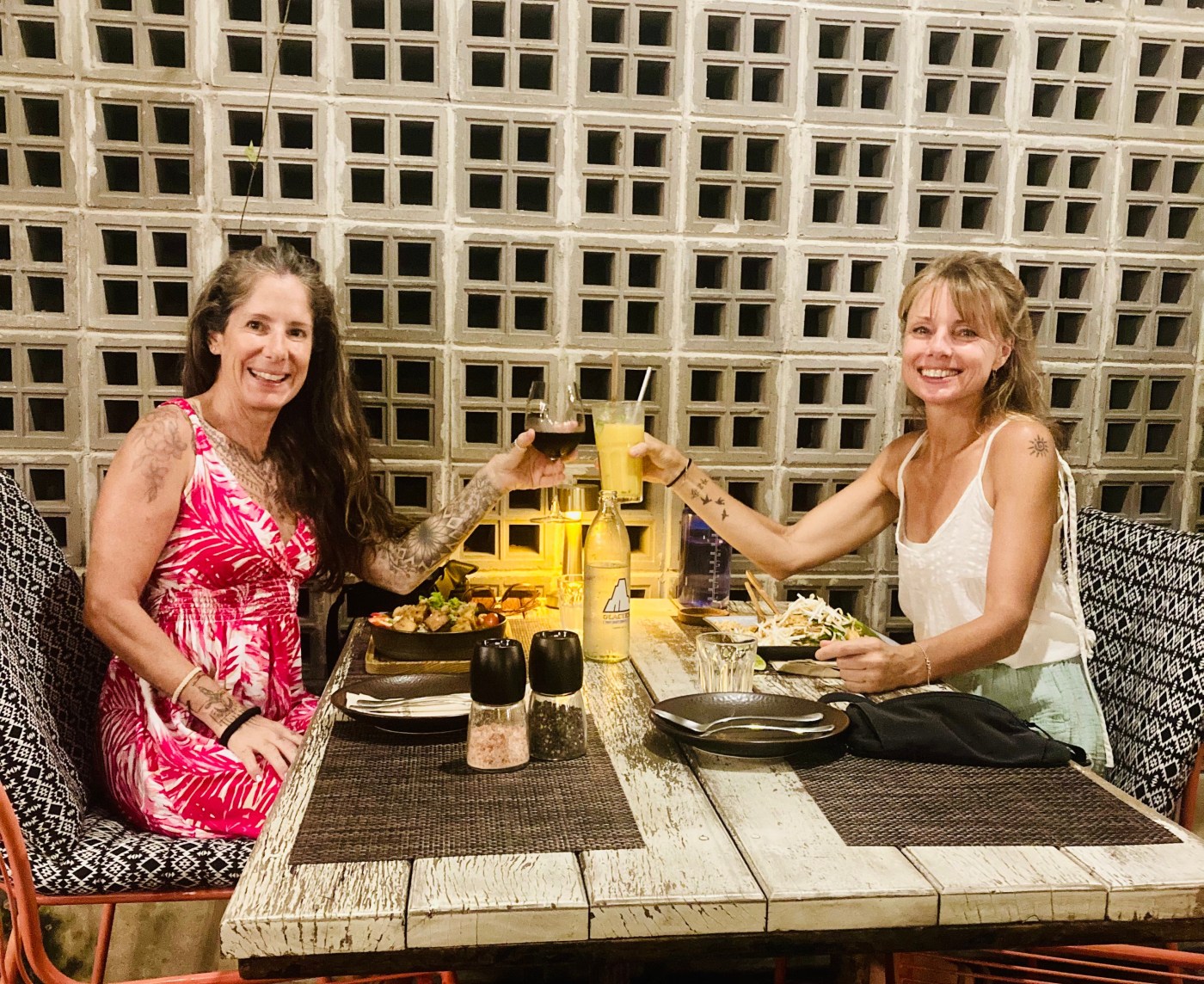
Photo: I wrote this piece a few hours before my friend Maria, a fellow Canadian, arrived at my home for a sound bath. She greeted me with flowers and then took me out for dinner as a gesture of gratitude for the sound bath. I love this… how beautiful that this visit coincided with Thanksgiving. And it’s funny that flowers and dinner were examples I used in this writing! Coincidence or manifestation?? Thank you, dear Maria!
 colleen thornton
Colleen, you write so beautifully and simply, straight from the heart…everyone can relate to your words, they are so honest. Thank you…we really enjoyed your latest writing…and how great that your words were exemplified by your friends visit! 😀🙏😍
Keep up the great work, sick up that wonderful CM life and culture 👍 xx
LikeLiked by 1 person
Thank you ladies! (I know it’s always Miranda & Jill speaking here lol). I hope you are both well and happy! And I hope to see you both back here in CM sometime soon! Lots of love xx
LikeLike