The unconscious mind is quiet and murky. It hides things until we’re forced to find them, like a riptide, deceptively calm with nothing too frightening detectable on the surface. Every so often, it offers us a peek at bits and pieces of ourselves—the fragmented and forgotten things we’d rather ignore, like the contents of a kitchen junk drawer. It’s unpleasant, and the desire to turn away from the dark, swirling mass and float belly-up on the sunny side is strong.
But.
Every month, those pushed-down parts demand attention. It’s not a choice. I do not seek this. The unseen things seek the light of awareness.
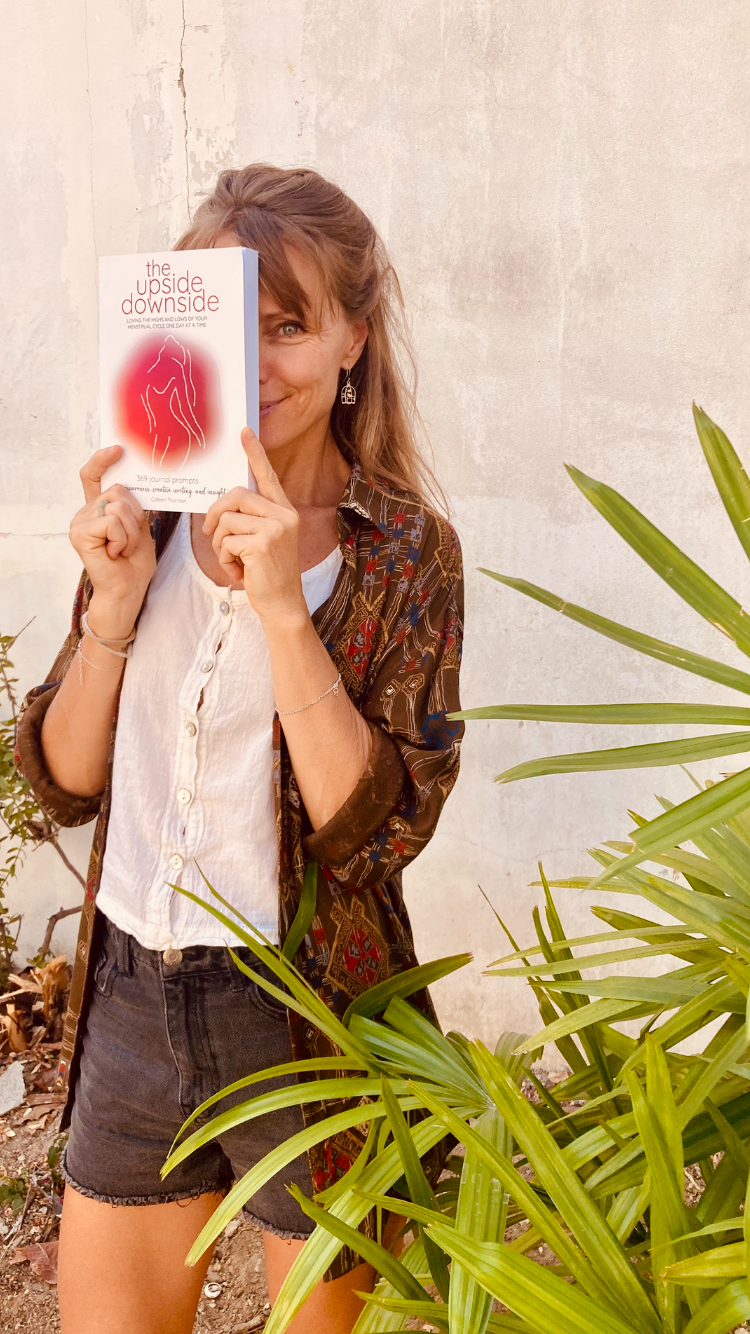
Why I wrote this book.
I used to hide in my closet and cry when the riptide arrived, usually on days 22-28 of my menstrual cycle. I’d push my clothes off to one side leaving a small pile for a pillow, tuck in to fit in, and close the doors. I’d shake and heave and squeeze my fists into tight little balls under my chin. Nevermind that I was a 40-something year-old woman with decades of experience bleeding once a month. I know this. It makes no difference.
Time can harden us towards some things, like over-calcified bones, rigid and brittle so as to become fragile and prone to fracture, rather than resilient. To soften towards unpleasant emotion and circumstances feels wrong somehow, because resistance has been a way of life, because we didn’t know that leaning in is not the same thing as wallowing, or that being overwhelmed is not the same thing as dying.
As women, especially as women, we learned that it was (is) safer to keep quiet and hide what is too heavy for some hearts, too threatening for some minds.
My closet was the only place I allowed myself to openly feel that intensely, even though I live alone and could “cathart” more comfortably in the wide open space of my living room on my soft, squishy couch. The emotions were glaring and dense and urgent in their expression, and I was afraid of them, afraid of myself for suffering without a reason. I wasn’t sick or dying or destitute. I was consumed by a sense of loss, hit once again by an internal tsunami, a big, dense, hulk of a thing that I didn’t understand, whose source I’d gleaned was PMS.
PMS. A limiting descriptor, stripped of context and nuance, useful only in substantiating its own inadequacy. A syndrome is commonly assigned to any condition we’ve not managed to fully understand because it includes a spectrum of “symptoms”—pointers to something unknown. Who would bother even attempting to understand women’s erratic emotions?—don’t dare fan that fire. Lock her up, or rather, teach her how to lock herself up.
Whenever I felt the tempest approaching, my closet was the safest place, and what seemed like the only place, to release the tidal waves of grief and the fires of rage. At least then they would not leak out and stain my put-together pretty things or burn my bridges to an outward sanity. I often kicked the walls of my closet like a feral thing, trapped in by the force of some hands other than just my own. Sometimes my kitchen nook sufficed as a holding place and so I’d take to the floor to ride out the storm. Always, there was some part of ‘me’ peering through a pinhole, watching the drama unfold. In the small, enclosed space I felt protected, yet forced to confront myself. I watched this body thrash and this mind root through every piece of trash, and I willed the storm to pass. I wailed. I waited. Eventually, it waned.
I know I risk sounding mawkish and melodramatic. But.
Those closet and kitchen floor events were so serious, so heavy-duty and demanding of my attention. For a time, they were necessary and effective. I didn’t intentionally relegate myself to small, dark spaces, but the body sometimes has its own way of dealing with the stuff we have willfully or unwillfully resisted for a long time. The mind hurries after it with explanations that don’t suffice, seductive as they are.
For years I’d pushed down feelings I’d learned were “difficult”, “unacceptable”, or “inappropriate”— all of which arrived quite regularly about 10 days before my monthly bleed, which is to say that I spent about a third of my awake life actively rejecting what was living and breathing in my body until it grew to a beast, and another day or two recovering from the inevitable emotional crash. It wasn’t (isn’t) depression, anxiety, a mood disorder, bipolar disorder, or psychosis. I realize now that it also wasn’t (isn’t) selfish or self-absorbed or navel-gazy to be with feelings, no matter their bigness, or how unwanted, uninvited, and discomfiting they are.
Those episodes were a fierce wake up call to identify blind spots, salve old wounds, and set new boundaries. To see all the ways I’d been resisting what is natural and ignoring what had been asking for my love and attention. To know my heart and mind intimately so as to consciously integrate the beastly with the beautiful. They shook the old coat of my body because it needed shaking. That’s how we wake something up that would rather stay asleep.
Writing this book has led me to a place where I no longer need it. Its job was (is) to confront, disrupt, and nurture the self into full acceptance. To take the significance out of what is part of the human condition. So we can stop taking ourselves and our humanness and this life so seriously.
It’s to hold our eyes open when we don’t want to look and say ready or not, here I come.
Writing can prepare us to meet what wants to be seen, even before it rises to the conscious mind’s eye. It’s a method for encouraging the hidden, unnerving things up and out. When we can write privately to ourselves about all the ways we don’t feel at home in our bodies or the world, about what’s hard to feel or has been deemed wrong or inappropriate or labeled as hysterical, then eventually we can talk about it with close others.
Then deeper, more courageous questions will arise, along with the willingness to hear the answers. We can extract meaning, and then toss that meaning to the wind and find lightness in all the comings and goings of our lives, through all the ups and downs of the feminine cycle. And discover the freedom between story and self, the truth between illusion and interpretation, and the richness of being, just being, alive.
 colleen thornton
Hi Colleen,
You are such a great writer! I’m so sorry you had to go through that every month. I hope it isn’t as bad as it used to be. I hear you’re having company on Monday. Thanks for being in touch with Shannon & Dianne’s friends. They are a nice couple.
Love you Dad xoxo
>
LikeLike
Excellent capture of how Shame manifests and takes a hold of our lives as women during the stages of our cycle that have not fully been accepted by society… and sadly… not fully accepting ourselves during those times either… The rawness and truth of your experience ripples through centuries of women feeling alone in that closet without any support or deeper understanding of what on EARTH is going on with our bodies !!! Let’s reach them!!! Matriarchy here we comeeeee!
LikeLike
hot damn girl, thank you for this powerful comment!
LikeLike