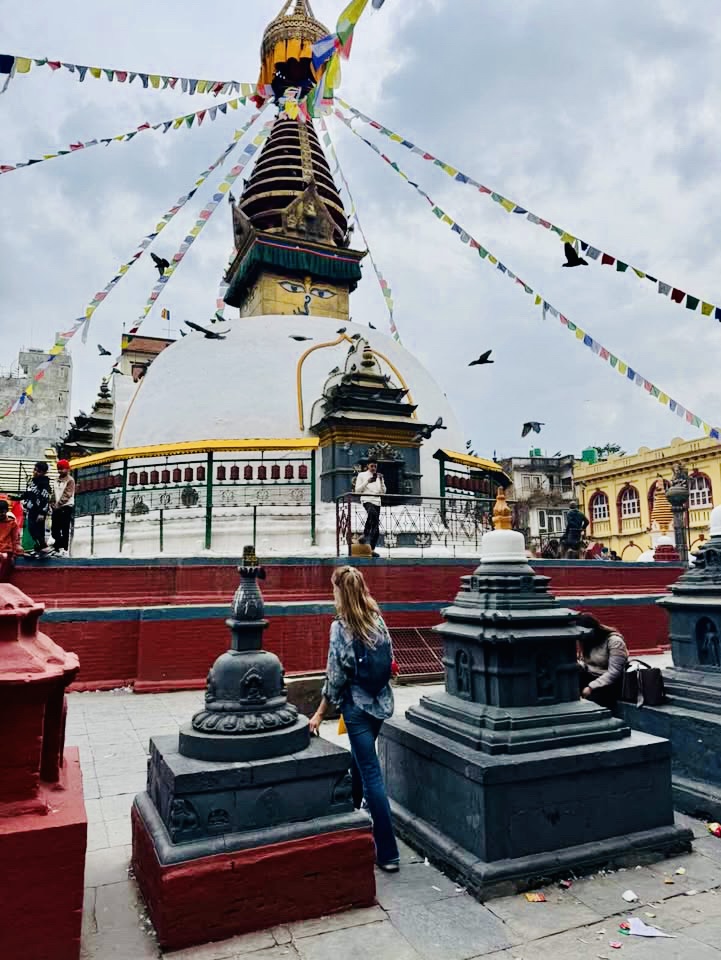
On my first visit to Pokhara in 2013, I witnessed the birth of a puppy on the rugged bank of Fewa Lake. I’d just finished hiking the Annapurna circuit and was devoted to the task of resting my weary bones and sipping a beer while soaking in post-trek bliss. Cradled by the mountains I’d been communing with the previous three weeks, I watched this fuzzy new life take shape in the world while black crows overhead cawed out a message of welcome. Later that evening, I returned to that same patch of grass on the lakeside and witnessed something else—the antithesis of new life. Two local men pulled a human body from Fewa’s waters. The same all-seeing crows (I’m sure they were the same crows) scratched caws of farewell across the sky. I don’t know the details behind this sodden corpse or why the men dragged it out like the most ordinary thing in the world. But the juxtaposition of reverence and repulsion hit me at once, and I felt a kind of unmoored awe for Pokhara that all these years later has yet to fade.
There are few places in the world that strike like this—that imprint their own inky fingerprint upon a porous heart, so to speak. Whose character is so wholly honest and unvarnished that we simply melt into it, both awestruck and at one with its bare, invisible bones. Different places touch different people, but we all have one—or eleven, depending on how thoroughly we’ve travelled.
In 2025, I returned to Pokhara, a sense of nostalgia for the past 12 years smeared across the windows of the bus from Kathmandu. Almost two seven-year life cycles later and with a different set of joys and sorrows than before, my feet touched familiar ground and the feeling was instant. That same sense of awe. I watched a large black crow fly overhead and join its clan in a nearby tree, cawing the caw of some childhood memory. I’d grown up in the Pacific Northwest, perched beside the Rocky Mountains and privy to the music and movements of black crows. But having left home decades ago, I’d long forgotten those birds. I’d also forgotten their cameo role on the birth-death day.
As days turned to weeks, the crows became even more prominent. I’d sit up on my rooftop that lent an extraordinary view of the Annapurna range and Macchapucchare and watch them gather in a single tree, cry the raspy caws of a 100-year cigar smoker, and scatter again. I was bewitched. It was as though they had messages to deliver, stories to tell the clan, and secrets to carry off to some distant place.
I finally asked a local woman if the crows were symbolic to Nepali culture.
“Oh yes,” she said, “they carry omens.”
“You mean they’re seen as negative?” I pressed.
“Yes, they symbolize death,” she explained. “We must give the crows food to prevent misfortune.”
Later, I learned about Tihar in Nepal—an annual Hindu festival of lights that begins with a day devoted to worshipping crows. This first day is called Kaag Tihar, or Kaag Puja—Kaag meaning crow. Crows are regarded as messengers of Yamaraj, which is the God of Death in Hindu mythology. Offering them food is a gesture of respect, of honour, as well as a request to carry positive messages to Yamaraj, thereby ensuring protection.
I love this. To worship what we regard as negative and foreboding. To honour a thing that symbolizes that the potential for adversity is always at our doorstep. To acknowledge that our own disappearance as just another life form on this planet is as much a part of the cosmic cycle as our flesh-and-bone bodies. To both accept and revere the ordinariness of life and death and be cradled by their in-between.
And isn’t that why we travel? Yes, for the taste of newness on our tongues and the views of unrepeatable first-times. But also to lose ourselves to a place, to forget why we are here, and then to remember again. To rediscover again and again that it has nothing to do with us.


Leave a comment