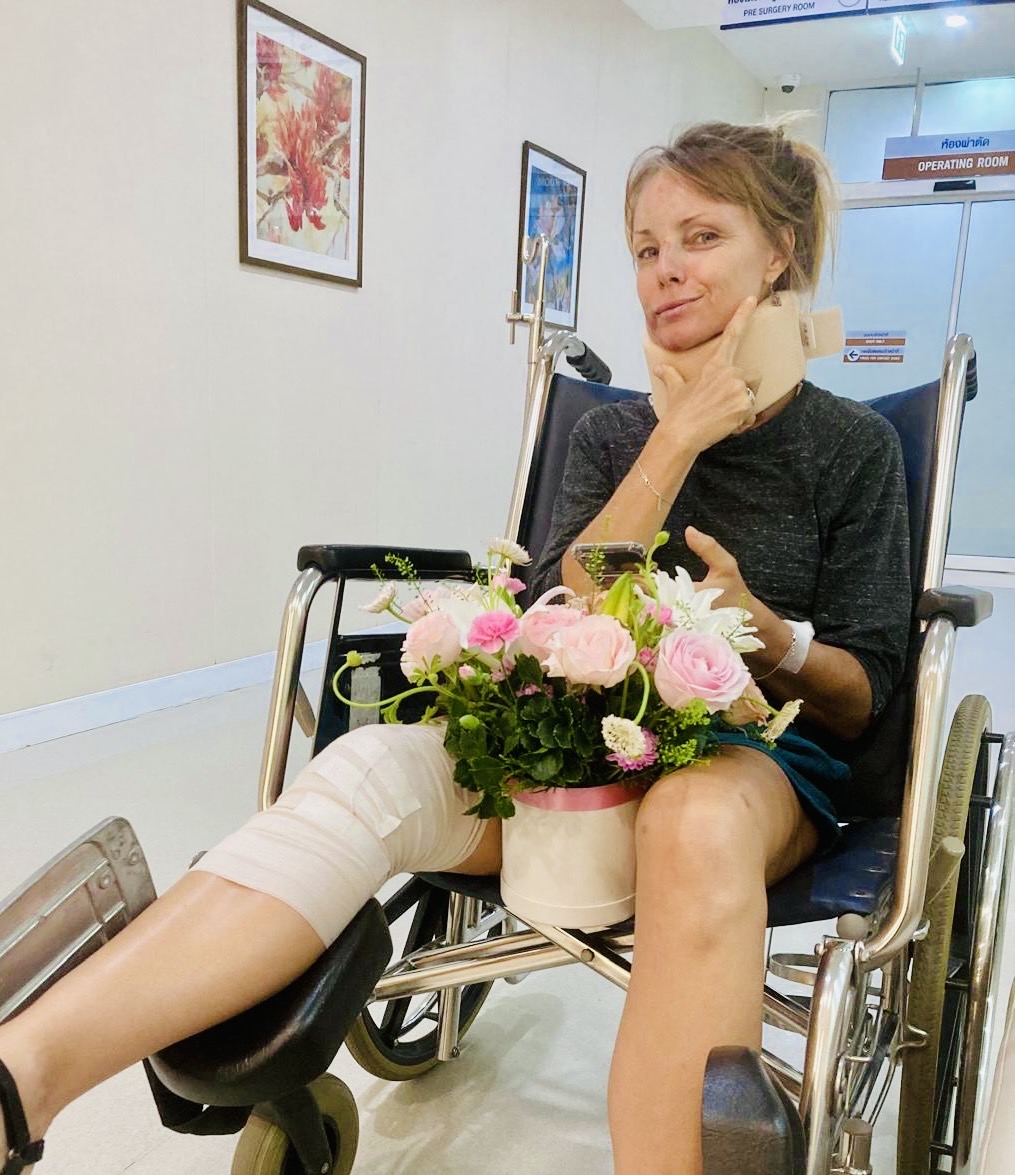
Six months ago I was hit by a car. I was driving my motorbike up Doi Suthep and just a couple hundred metres from the temple on a hairpin turn, a car appeared directly in front of me. It happened so fast, I barely registered it. All I remember in that millisecond was a sharp and dissonant split in time. I felt the crunch and the jolt forward about the same time I realized that the car was in the very wrong place on the road—but also in the very right place. When you can’t believe what’s happening as it’s happening, you either pass out or non-duality inhabits that split as you become the thing you are colliding with—that’s how you know it’s also the right place—it’s the truth of what’s happening. I didn’t pass out.
There are so many strange details surrounding that incident, I hardly know where to begin. But I’ll start by acknowledging the paradox: the “accident” was one part a grave injustice, another part destined to happen, and another part just a set of conditions arising and momentarily intersecting. I was torn about how to view what had happened. Should I believe that I manifested it because I had asked to die that day? Should I give it a nihilistic shrug—“shit happens”—and soldier on? Should I accept it as a mysterious blessing because it could have been worse? The truth is that six months later I still have not settled on one perspective. They all have strands of truth. So, I’ll set about telling the parts of the story that still strike some place in me when their faces surface from the well of memory.
You might have noticed that I wrote “I had asked to die that day.” It’s true. That morning, I’d had one of my all-out showdowns with myself, a regularly occurring feature of my menstrual cycle, and as intense as it was familiar (read past exposition in Hide & Seek). Familiarity does not dull the edges, by the way. I fought hard that morning, Day 2 of my cycle, tearing through pages in my journal writing words so honest and violent they terrified me:
What tragic thing do I think is going to happen if I decide not to move for the day, or at least for the morning? Am I going to die? Lose my mind? Is my whole world going to crumble because I decided to sit and journal instead of pushing out more rotations on Day 2 of my cycle? I need to die—I need to undergo some kind of ego or old-me suicide, let’s call it assisted death… the grand narrative is that death is frightening, something to be avoided, BUT I NEED TO DIE—the old me needs to die. How can I assist this, facilitate this?
Then, I talked to my uterus.
I actually did. I’d never done that before. I did not even know I was the type of person who would talk to her internal organs—and furthermore, expect a reply. And, as often happens on those first blood days, something miraculous occurred: she spoke back: Go to the water. So, I threw on yesterday’s clothes, grabbed my keys, and drove to the mountain where I spent an hour flattened like a shadow on a rock in the sunlight with the sound of water rushing around me. I let the angst unravel and find its way to the cascade. Then, it came time to go and I sat there on my motorbike torn between which way to turn. Should I go back home and attempt to do the things I need to do, in spite of existential distress since that happens every month? Or, should I fuck off for another hour and drive up the mountain to my favourite viewpoint for a coffee and a bag of chips? Back and forth. Responsible. Irresponsible. Draconian. Self-indulgent. Fight it. Let it be.
Eventually, I turned left and started the drive up the winding mountain road. It was a beautiful October day, high noon, and trees cast just the right amount of shade so that I dipped in and out of shadow and light almost rhythmically with each turn. Pink Floyd’s Brain Damage tracked through the back of my mind and out through my mouth… You raise the blade, you make the change, you re-arrange me ’till I’m sane, you lock the door, and throw away the key, there’s someone in my head but it’s not me… The air became cool and fresh on my bare skin, and as I ascended the mountain, I felt like I was simultaneously flying away and finding my ground. It was four days before my 47th birthday—a day I wish to boycott most years. It was also a dark moon—almost to the minute, which I found significant in the following weeks. Yes, driving up the mountain was the right thing to do. Sometimes you just need a waterfall, a mountain, a coffee, and a bag of chips for the darkness to lift.
I drove about 11 km when suddenly the car appeared, its headlights like the eyes of a menacing face. After that momentary time warp, and the feeling of being crunched up like an aluminum can, I realized that I was on my hands and knees at the side of the road, my cheek pressed to the pavement in a rather gnarly chatarunga pose. Instantly, I was aware of my teeth, which my tongue roamed around for and found intact. Then, the moment I became aware that I’d been thrown from my motorbike. Have I been hit? Wait, was someone else hit? Had I done something wrong? What happened? Is this a global thing—did the earth shift? Did I just get hit by a car? I didn’t move from that position. My helmet was still on and clasped though the visor had flopped down and was smeared with blood. Nothing hurt but there was some pressure in my right knee. A man approached me. A nice, gentle face with a neutral expression.
“Are you okay?” He asked. He must have seen what happened, I thought.
“What happened?” I asked.
“I’m so sorry. I’m so stupid,” he said.
“Did you hit me?” I asked, confused. Why did he appear so calm?
“Yes,” he said, now smiling nervously. “I’m sorry.”
“What happened?” I asked again. He gave me the same “stupid” reply. I stopped asking.
A few more people approached. Umbrellas appeared. I heard a whistle. Someone helped me remove my helmet and lie down. A woman cradled my head and shoulders in her lap. The sun was glaring and I was thirsty. Something was wrong with my knee, and my front teeth felt dented, pushed back, but still there.
“My knee,” I said.
“Yes, better not look,” someone replied.
The woman asked if she could call someone. “Yes, please call my friend Alan,” I responded. With her help we found my phone and called. Someone was calling an ambulance.
Someone gave me water and as I lifted my head to drink I felt faint. I had been fasting since the previous night. I remembered that I had put on yesterday’s clothes and recalled my mother’s sentiment in my childhood about always wearing clean underwear in case I was ever in an accident. So, there’s truth to those silly superstitions.
A man with dark curly hair sat in front of me. I reached out for his hand. “Who are you?” I asked.
“I saw the crash,” he said. “You passed me. I pulled over to put on my jacket, and you passed me. It could’ve been me.” But it wasn’t, I thought. I held his hand until the ambulance arrived 40 minutes later. I didn’t get his name. A paramedic cleaned my knee and then I was lifted onto a stretcher and carried to the ambulance. I’d never been in an ambulance before. The worst injury I’d ever had was falling off my bike when I was 10 years old. The worst part of that wipeout was the stinging bath that followed. (And it’s interesting to note that, just two days before this accident, I’d written and posted a blog that described that incident and touched on dying).
Five doctors inspected me at Bangkok Hospital: an ER doctor. An orthopedic surgeon for my knee, which had been lacerated to the kneecap, my broken thumb, and two fractured cervical bones. A neurologist for the tennis ball contusion my forehead had sustained even with a helmet on. A dentist for my teeth, which had minor chips. A cardiologist for good measure I assume. I had a smattering of scans and tests performed. Lucky me. My whole body shook at one point, which I assumed was its built-in mechanism for relieving the shock of the impact from my body’s tissues. Brilliant by design. I gave the trembling free reign. Alan had arrived, and he held my hand as we joked about the state of my knee. “It’s not that bad,” he said. “Can you see the kneecap?” I asked. He hesitated, then nodded. We laughed at the fact that I refused to look at my face. “It’s not that bad,” he said. It felt like a Picasso painting. The ER doctor urged me to stay the night for observation but I insisted I was fine. I ended up staying. But I was okay. I was alive. It really wasn’t that bad. It got bad a few days after, but even that eventually ended, as things do.
* * *
I probably hung on to the accident a little longer than necessary, which is to say I found myself emotionally attached to it. It became “my” accident and I told the story to anyone who would listen. Because even when negative events or a phase of adversity eventually fades from our lives, there can still be an accompanying grief. Fear and loss are seductive this way. We don’t often like to let go, even of the pain and suffering. There’s something oddly reassuring in the meaning they bestow upon our lives for a little while. Few things make us feel more alive than the very tangible risk of death. My head wound caused vertigo and other problems for several weeks after, and the injuries brought up some old monster-under-the-bed type of fears that haunted me sporadically for many months. I reckon it’s a kind of nervous system recalibration and the mind interjects with its own opus. For longer than was comfortable, I lost a certain autonomy and agency that are the hallmarks of self-esteem. I couldn’t play my bowls for nearly two months because even a gentle strike of a favourite one would send the room spinning. Shifting from one position to another could cause my blood pressure to rapidly drop. I was afraid these conditions might never improve.
It was a really horrible time of reckoning. To acknowledge how much ease I routinely take for granted, like the best of us. It could have been far worse. And it could have been better. I didn’t know that, since the only reference I had was that bicycle crash when I was 10 years old. Getting hit by a car at 47 takes a little longer to recover from.
The man who hit me while his attention was elsewhere did what he could (rather his wife did all she claimed she could while he hid in the shadows). While I accept that, it was unfortunately not enough. Where we put our attention can have life-and-death consequences for ourselves and others. Mostly for ourselves because we have to live with whatever the fallout is. Those words I wrote, the thing I wished for on a difficult morning, also had its consequence: they were the precognitive blunt instrument warning me to be-aware of my own darkness. Not to run from it, but to notice where it’s leading me. Ha. The hindsight of foresight.
In the following weeks, I thought so many times: this must be more than a random accident on a Tuesday afternoon. Given my request, the accident must be a sort of providence that shook me to not kill me. Or perhaps that car had intervened and prevented a greater tragedy. Maybe I was the fortuitous character in a story that belongs to the man I’d passed, who’d stopped to put on his jacket. You never know how events will unfold. As for the why—the possibilities are endless and ripe for picking.
Example:
Two days before the accident, right about the time I wrote that blog on dying I mentioned earlier, I received an “oracle” in a cup of coffee. The espresso foam shape-shifted into the form of a human torso, and I watched as it was catapulted forward in the slowest motion, head now a thrown ball drifting through space. I noticed this after the accident when I watched the video I’d captured of it. It was as plain as day. That’s cherry-picking. That’s not wanting to let go. That’s grief.
I also thought about how just days before my 19th birthday my grandmother had died in water, by choice, and how on the day of the accident, just days before my birthday, my uterus had told me to go to the water, and then of the rampant speculation about ancestral trauma. That’s connecting dots where there are dots to be connected—which is everywhere. That’s not wanting to let go. That’s grief.
The assigned significance of the accident happening almost to the minute of the dark moon which symbolizes invisibility, the void, darkness, the old moon being taken in the new moon’s arms. Dying. That’s not wanting to let go. That’s grief.
Then—this:
Months after the accident, I finally tracked down the guy whose hand I held—the guy who’d stopped to put on his jacket. He told me a story that sent my mind spinning (figuratively now) about an omen he’d received a month before the accident. An omen from the mouths of three separate and unrelated shamans in Mongolia. The exact same omen: in one month… an accident… a lot of blood. Though he is a non-believer of this type of stuff, through some rituals, the shamans “cleared” him.
Did the accident somehow bounce over to me—the nearest and most vulnerable target given her documented request to die? Had some malevolent force witnessed these conditions and “dropped” an unfortunate event into a susceptible host? Are events just floating around us like dust motes, waiting to land somewhere? If the same can be believed about inspiration, why not what we perceive as negative? Well, said a friend, that would be believing that the universe is malicious. Or, is the universe just balanced? Who decides what is bad or tragic other than the person perceiving it through her own veiled eyes? The one who grasps for meaning. The one who doesn’t want to let go. The one grieving.
So, piece all those parts together: the journal entry, the coffee oracle, the omen, the ancestral story, the new moon, the event occurring 200 metres from one of the most auspicious places in Thailand. Destiny, right? Maybe. Probably. I don’t know.
Or maybe this:
Since that day, the day of the accident, I have not wished to die. Not because I “learned my lesson” and shut down all such thoughts about dying, but because I don’t cyclically wish that anymore. The truth is that part of me did die—the part that every month was hitched to hanging on to what my body was dying to let go. I got what I asked for, albeit in a painful way. I suffered for a better outcome because sometimes that’s necessary. Sometimes the truth has to literally hit us in the face if we’re not picking up its loose threads and stitching them together. That’s some kind of power—to get what you ask for—and I can learn to redirect it.
This occurrence of events is not so mystical, though. I understand it as the human need for our lives to be significant in some way, to find or make meaning of both the mundane and the miraculous. To weave stories as a way to leave something of ourselves behind. In “my accident” story, it was the interplay of old grief forced to the surface, its spores released to open air, and a few changes I didn’t have any choice but to make. For the first time in my life, I slowed down without a crutch—without a cigarette, or a glass of wine, without a microdose. I rested and slept loads of daytime hours away. I watched my plants grow in real time. I wrestled mentally with inactivity and insecurity and boredom until I just gave into them. I barely even wrote. I felt my body become one with my couch. I ate because an insatiable hunger came over me for a while, and I put some more meat on my bones. I faced terrifying nighttime anxiety that sometimes also showed up in the light of day. I had time to contemplate all the different ways of interpreting the event and realized I could choose what made me feel most at ease. I had space to come to terms with the fact that grief is not the same thing as regret, but that continuing to push it down might make it feel that way all the while eroding self-trust. Slowly, I got better.
It’s not a riveting story—but it helps me make sense and find closure. And with time, equanimity. Attention is displaced. Accidents happen. Heads are wounded. Coffee foam is analyzed. Words are interpreted. Meaning is woven. Destiny is outsourced. Stories are told. Bodies are healed. And life goes on… until it doesn’t anymore.
Be-aware of darkness. Be mindful of what you wish for.
And keep your eyes on the road.


Leave a Reply