
I spotted this epigram of sorts, “Open to More”, printed on a shop sign when walking from the bus station upon arriving in Pokhara, Nepal back in March. I’d just finished a harrowing nine-hour bus journey from Kathmandu, and was making my way on foot to my guesthouse. Taxis were available, but my legs needed some movement, and walking is a great way to get acquainted with new surroundings. I’d been to Pokhara 12 years before, following the Annapurna Circuit trek (see photo below), but I’d spent those few days at a yoga retreat. So, Pokhara was largely unfamiliar.
The blue Open To More sign featured a background design of green concentric circles. That first day, I assumed it was the name of a shop or restaurant, and I took note of it because it was creative, somewhat insightful. But in the coming days, I noticed that this sign was everywhere, confusingly, and the only difference was the actual name of the shop printed next to Open To More. It signaled cafes, sundries stores, snack shops, restaurants—a seemingly random assortment of businesses. I didn’t see any symbolism in this sign until later on in my stay, and when I did, everything just kind of landed, though not without the requisite discomfort that usually accompanies meaning making.
Following that three-week trek through the Himalaya back in 2013 when my marriage had just ended, I vowed to return to Pokhara at some point because I liked the feel of the place. Whether that’s because I was in the midst of a grand mal life disruption and it was far away from everything familiar, or because I was nestled in a valley surrounded by the tallest mountains in the world, I don’t know—maybe both. I recall that in the one day I’d spent in Pokhara back then I’d witnessed the birth of a baby goat in the morning and, that evening, watched as a dead human body was pulled out from the lake: the full cycle of life in one day, right at the end of a once-in-a-lifetime adventure. Death and rebirth all laid out like laundry drying in the sun.
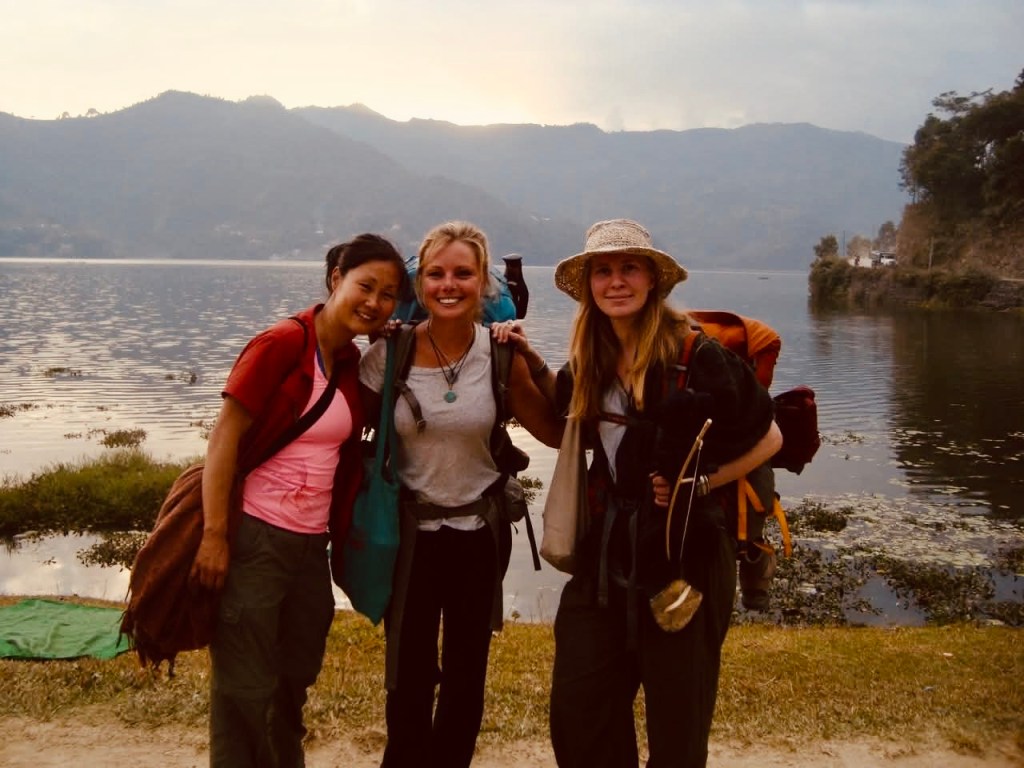
During one of several morning hikes on this recent trip, I realized how many once-in-a-lifetime experiences I’ve actually had over the past 13 years. I’ve walked the Camino de Santiago four times, trekked the Himalaya twice, bought and sold homes, been married (and divorced), hiked numerous volcanoes at sunrise, visited remote tropical islands, written and published a book—two books! And more… and I assume I’m roughly halfway through my life. I don’t mean to take an inventory of my experiences or to flash my privilege, but rather to express deep gratitude for this life and all it offers. To recognize that tough choices can lead to great outcomes, and to contemplate how “more” isn’t so much about circumstances and material means as it is openness of mind and perspective, curiosity, mystery, dissonance. About how everything, in all its discord and harmony, belongs just as it is and also as a catalyst for what else might be. And doesn’t everything occur just once in a lifetime, and somehow all at once, even if it seems the same and along some timeline?
My escape from Chiang Mai was long overdue. Having spent the previous three burning seasons double-masked and miserable amid a haze of smog, I vowed that this year would be the year I’d get out. I gave up my usual excuses and booked my trip with a sole objective, well three, actually: to escape the smog, to climb a fucking mountain, and to get “unstuck” from this middle-age trap I find myself in, which is likely more an issue of perspective than of chronological age. And then I arrived in Boudhanath, home of the great white Boudha Stupa with its slightly menacing Buddha eyes that follow you everywhere. It was cold, gray, and polluted, and I spent three days looking forward to leaving. Then I arrived in Pokhara, and on that long, weighted walk from the bus station, I finally conceded to the fact that I was confronting what I’d hoped to escape. Funny how life does that. I bought a mask and hauled my weary bones and backpack to my guesthouse.
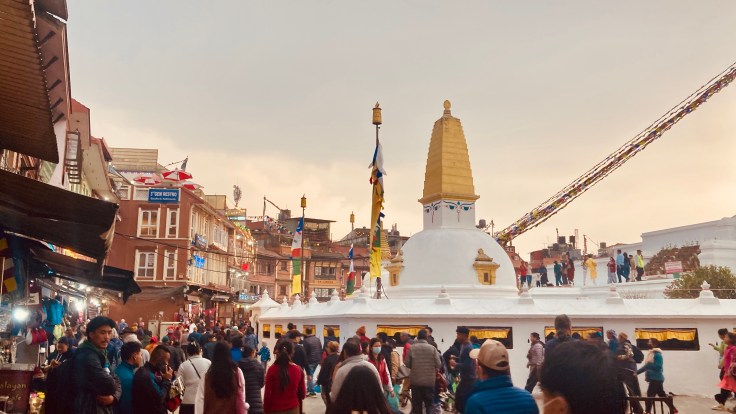
There were a handful of smoggy days during the first month I was there, and in my usual fashion, I flip-flopped between staying and leaving. I asked too many people for advice. I checked Sky Scanner for cheap flights to “everywhere” until it timed out. I made pros and cons lists from different angles. I was also dealing with trigger finger, an annoying degenerative condition that kept my left thumb in a straight and locked position and caused sharp pain and a gnarly snapping sensation whenever my thumb reflexively bent, as thumbs do. I’d been told I needed surgery. All of this was happening alongside chronic relationship troubles and ineffective behaviour patterns that seemed destined to continue their incessant looping ad infinitum, and that get me no closer to the truth as the years charge on. You know, just normal life stuff.
The thing was though, I had my heart set on Pokhara. I wanted to hike every day, walk along the lake, and stare at the majestic mountains until my eyes burned. I wanted to smell the arrival of spring and make friends with the moss. I wanted to watch the tails of cows that wander the town’s streets twitch back and forth and continue my enchantment with broken roads and filthy feet. I wanted to say namaste many, many more times. I wanted to commune with the thousand crows that inhabit those mountains and that remind me of where I come from. But I also wanted to breathe fresh clean air, and while those aren’t competing desires, it wasn’t possible to fulfill them all at the same time. Yet, I was determined to make it work. It would’ve been easy to throw down another few hundred dollars to get on a plane and arrive in some ever elusive perfect place, but something kept my feet firmly planted. Perhaps it was the grounding effect of being surrounded by mountains, or my waning tolerance for my often flighty, flaky decision-making—whatever it was it made me stay. I reckoned there must be some other reason why I was there, since it obviously wasn’t to escape the smog. So I settled into some very mundane reasons to just be where I found myself, which included watering someone else’s plants, giving the neighbourhood kids Pokemon cards, watching the blobby persimmon sun rise and set. As it turns out, such things are far from mundane and, along with my growing communion with crows, gave me reasons to stay and slow down. I spent that first month hiking, strolling, making a few friends, writing, doing forest face plants, thinking, watching trees grow tender new shoots, conspiring new ways to interact with the neighbourhood kids, noticing the sound of my breath and the feeling of my feet reunited with a pair of hiking boots—my God, how I missed that feeling!

And then I found Nirvana Singing Bowls, thanks to a lovely young woman I met one morning at sunrise. I attended the morning mantra chanting group, the idea of which both thrilled me because I love to sing and unsettled me since I’ve experienced my fair share of phoney spiritual groups. From the moment I met Kamal, the young Nepali man leading the group, I loved it. I loved that it was more singing than chanting. I loved the way he broke down the sound Aum into three parts (and when you repeat Aum many times, it starts to sound a lot like home). I loved how he reminded us to keep the head slightly upturned and to sing from the heart, and how literal that actually is since the further down we begin to sing, the more resonant the sound is. I loved the way he spoke of singing and breathing and peeing away our inherent darkness, and how he said “different different mantras” in his charming Nepali accent instead of “many different mantras”. I loved discovering how inessential it is to know the literal meaning of a given mantra to truly feel it because man-tra translates to “mind free”, and any meaning we try to attach to a thing of the heart always falls short when we involve the mind. I loved nestling into that space every morning following my hike and marvelling at the collection of empty brass bowls in the center of the room. They didn’t even need to make sound for me to soak up their good vibrations.
After a few weeks of morning chanting and a sound bath experience, I signed up for his training in vibration and singing bowls. And I thought, well if I keep circling around and around and around in life, let me at least make it sound beautiful! That’s when I clued into why I was there. It was to loop back to something I’d not lost, but had allowed to stagnate—to become reacquainted with one of the oldest parts of myself—my voice. And to use my voice to complement these beautiful brass bowls. It wasn’t until I sat down to write a piece for my monthly writer’s workshop, and that I later titled Doorway to God, that I realized what was happening.
All my life, I’ve loved to sing. As a teenager, I spent hours holed up in my room singing Pink Floyd songs, and “playing the strings til my fingers were raw”. Time passed and dropped away, and day became night and there was nothing else I wanted to do but sing and strum. My voice has also been a self-regulation tool over the years, and I was totally unaware of that until I wrote that piece. I recount times I’ve been in precarious or dangerous or unnerving situations, and I’ve begun to sing from sheer instinct, not even aware that I was singing: Being robbed at knifepoint. Eating too much cannabis. Crossing the Thorong-La pass in the thinnest air I’d ever experienced. Walking through a pack of scary stray dogs. About to paraglide. Walking the abrasive and heartbreaking streets of central Kolkata, alone and fragile. Crawling up Rinjani volcano. Ironically, before singing Oh Canada to an audience of 1000+ people. Arriving in Surabaya, Indonesia where I was to live the following two years. Just before surgery. Having blood taken. In the throes of a panic attack. Most recently, walking through a snow and hail storm on the edge of a high mountain pass with the wind threatening to whisk me away into thin air. I sang my way down from anxiety with anything from lalalalala to Led Zeppelin to the Little Mermaid. I can’t think of a better alternative to Xanax, and if my voice has such a profoundly calming effect on me, perhaps every single one of our voices (believed to be good or terrible) has a similar effect on our nervous systems. It amazes me to know, now on a conscious level, that a few ahhhs or mmms can create a total shift, not just in mood but in physiological state. I think we can all attest to the benefits of such inner shifts.
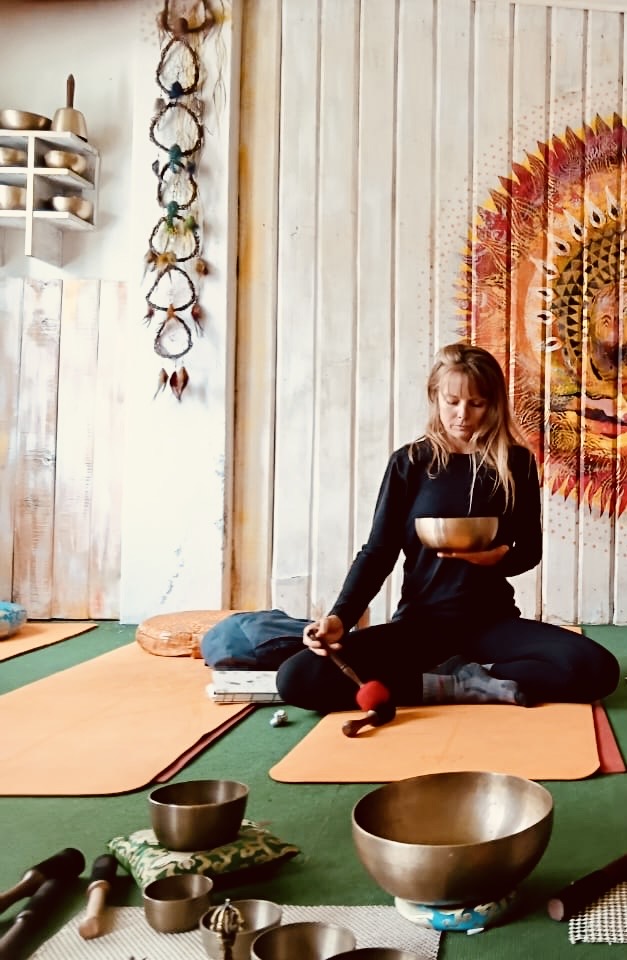
Enter the bowls. Not only do they vibrate at frequencies that affect healing in ways I can’t even begin to understand, they teach me to sing intuitively and, somehow, with greater intention. To follow my voice wherever it wants to go at that moment. They teach me more lessons with each passing day: how gently holding the mallet produces a smoother, more continuous sound than a fixed and firm grip does, and how the slower and steadier my hand rims the bowl (“easy your hand” in Kamal’s words), the more varied and numerous and resonant the tones are. How playing two bowls together, not with a narrow plan but rather in the wide open space of curiosity, often produces either a “difference tone” or “resultant tone”, in which a new tone is produced or perceived when two tones of different frequencies interact, and which for me runs sweetly parallel to Donald Hall’s “third thing”.* And every time it happens, I’m struck by surprise and awe at the mystery of it, and humbled by my inability to repeat it. For it too is once in a lifetime.
The bowls are also symbolic of receptivity and holding, space, possibility, potential, the capacity to receive. Creation. Eternally “open to more”—the readiness to be filled anew, and, as part of the cycle of life, emptied back out when the season calls for it. Capable of producing something wonderful, unsettling, discordant, melodic, and different every time I strike them. Melodious in their emptiness—precisely because of their emptiness. Moving me to tears of nostalgia as I join them in voice, and then in silent integration.
I cannot think of a better way to spend my time, especially as I sink more into this stage of life where I find myself no longer young, but also not old. Not who I was (which travelling solo again after almost a decade has shown me), but not sure yet who I am, or if I even need to know. Erikson said the main issue at this stage of life is generativity versus stagnation, and I mention it in the context of this story because, while all this singing of mantras and striking of bowls was going on, I had PRP therapy for my trigger thumb. Platelet-rich plasma therapy is a regenerative medicine, in which the plasma of one’s own blood is injected into the injured or degenerating—in my case locked and stagnant—joint. It uses the body’s own tissue to heal itself, rather than a foreign substance like cortisone. It’s not fast-acting, but few healthy and sustainable solutions are. One must patiently wait as the body heals its own damaged tissue, little by little, adjusting and responding to the subtle shifts, which include, perhaps, our own intimate contact with the world, with others, with our commitments and habits. It’s literally self-healing, much like Kamal says singing mantras are, and I can’t help but see the parallel between this physical issue and the more symbolic one of being stuck in a certain way of living or seeing or believing.
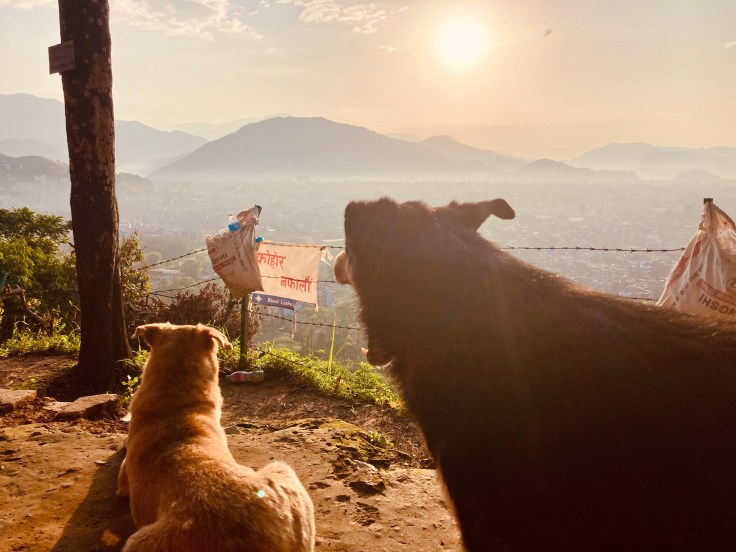
So, I met my objectives. I escaped Chiang Mai smog (next year, I’ll make my prayer more specific), and I climbed. And I climbed and I climbed and I climbed and I got stronger. I wanted to count all the days I climbed, all the steps I took, and then I realized how utterly pointless such a mental activity would be. So instead, I spoke silent prayers of safety to funnel spiders, and cawed with the crows, and laughed out loud in the middle of trees, and talked to the friendly dogs who oftentimes accompanied me, namaste’d my way through mountain villages, and gasped every single time I glimpsed those towering snow covered peaks. And I sang and I sang and I sang. I spoke to moss, and the moss spoke back, and somewhere off in the distance was a third sound. I’m not entirely sure what it was, but I am open to more of it.
*The Third Thing: Poet Donald Hall on the Secret to Lasting Love

 colleen thornton
spectacular
LikeLiked by 1 person
Bravo.
Such a wonderful gift you have,
to write so well about your experiences and observations.
Your ability to recognize and record your life so clearly leaves me awestruck and envious.
I appreciate your appreciation of wisdom.
It brought me peace to listen to your writing.
Harlan
LikeLiked by 1 person
Thank you Harlan
LikeLike