“I was waiting for something extraordinary to happen but as the years wasted on nothing ever did unless I caused it.” Charles Bukowski in Post Office (1971).
I really need to talk, he wrote. It’s probably better I tell you face to face. Colin’s text messages are infrequent and usually short, to the point. They’re reflections of his personality and the limited mobility of his right hand. On many occasions, I sat next to him and watched as he typed his brief “trip-reports”—detailed notes about his motorbike excursions, which in the past were off-road and covered most of Thailand. These days, his rides are confined to the paved roads of the 300 rai or 118 acres surrounding the rehabilitation and assisted living home where he lives, maybe for the rest of his life. To construct the day’s report, Colin’s left forefinger pecks each key at a pace like dialing a seven-digit number on a rotary phone. The first time I sat with him, guiding him through the steps for making a Facebook post, I jotted down notes, as detailed as possible, which he could refer to later when he was alone again. That cheat sheet looks worn and inadequate now.
It’s both painstaking and peaceful to witness a few words come to life on Colin’s computer screen. Five, maybe ten, minutes pass. The mustard curtains flutter with the breeze coming through the open window. A mynah bird perches on the grass for a moment. A leaf or two drops from a gnarled limb and drifts to the ground. The fridge’s hum commences keeping time like a metronome, and I shift in my chair, uncrossing and recrossing my legs, watching him persist in this daily task. He leans forward to see the keyboard, his shiny scalp reflecting light from the ceiling’s bare bulb, his dormant arm folded into his lap against his belly. A concentrated thought becomes a telegraphic mumble with a southern British lilt. A short, simple sentence appears on the screen, satisfied enough with itself to exist and name a thing or two.
Colin gets frustrated sometimes, every day forced to rely on a slip of paper for instructions on how to do something that in the past he managed with ease. In those times, he’ll swat the side of his head, mutter wanker, and threaten to give up, but he doesn’t mean it—not really. Maybe when he’s alone he does give up, at least for a while. Determined and patient as he is, nature doesn’t shield any of us from an occasional shitty day of self-defeat.
***
When I receive his text messages, I imagine Colin just that way—sitting at his desk, referring to his notes and stitching letters together as the clock ticks time away. It’s impossible to commit typos at that pace, and you’d think he selects only the most essential words. Yet each time, those messages begin unnecessarily albeit politely with my name. Coco when are you coming again? Uppercase C. Question mark. Each one requires the coordinated labour of tapping two keys at the same time. For all their effort, his messages hold the value of gold and the weight of guilt. There are no errors in the system, said the late and great spiritual teacher, Ram Dass. Sure doesn’t seem fair, though, this painstaking travail recently assigned to Colin. Only just to share a thought or two on social media about his morning ride. We’re born and eventually we die, maybe have a stroke or some disease in between. We get the body we get—some degree of a prison or a paradise, and that’s it—like it or lump it as my dad says. I never quite understood “lump it”, but I think he means live with it. Karma is convenient until it isn’t, and luck has a short lifespan.
Stroke victims, as we call them, don’t land equally. Left and right hemispheres of the brain have something to do with it. Ischemic or hemorrhagic. Age and lifestyle and urgency of care either improve or worsen long term outcome. I suppose Colin is one of the fortunate ones, since almost five years have passed since his stroke, and he is making a strong recovery. When he was struck, his left brain went offline for a moment, causing a bluster of confusion as important wires tripped and eventually fizzled out. I’m sure that’s not how medical texts describe strokes, but if the brain is anything like a circuit breaker, that’s probably a shade accurate. He says he was focused on writing those trip reports when it happened, which is unsurprising given he was usually out riding or writing about riding. Lucky for him he wasn’t riding when the stroke took him down, though once he questioned if that might have been a better fate. He would have died for sure, alone on some backroad in the middle of Thailand, which he reckons isn’t a bad way to go. But it happened as it did, and Colin accepts that fact like an apology. I’m here in Thailand, he affirms as he lifts and sweeps his one able arm in a gesture of pride. If I was in the UK, I’d be bloody miserable.
I answer his text messages promptly except when my life is busy. In those times, I let his message go unread for a few days and open it only when I’m capable of a generous reply. But this “I really need to talk to you face to face” is unusual for him. Colin isn’t prone to drama. His life is tidy, each minute of the day accounted for with all comings and goings predictable and scheduled far in advance. He keeps a small chest freezer in his room, stocked with three months worth of meals—a rotation of massaman gai, hung lai moo, and one or two other spicy Thai curries. The freezer and personal food supply are unnecessary since he eats in the “canteen” three times a day, but he loves his curries and has them on a strict rotation. I’m almost sure he’s asserting some control over the controllable for obvious reasons, and I reflect on the source of my own hoarding habits with a little discomfort.
His 1kg dumbbells sit on the floor next to the single bed that’s pushed up against the wall with the window. The velour top blanket features a smiling panda bear that might suddenly age if its pile were brushed in the opposite direction. It is folded down to reveal the underlying sheet and is tucked tightly under the mattress, reminding me of my childhood bed. A small tarnished spoon, slightly bent, sits atop his dresser next to the week’s food menu that features his left-handed scrawl. Inside his top drawer next to his folded briefs are a year’s supply of expired pumpkin pie spice in a giant wholesale plastic container and foiled packets of cocoa powder, stacked like the bricks he used to lay when he could still work. I doubt the spice mixture holds any of its original warm scent, since it has been there at least as long as I’ve known him, now close to a year. The food and those items are among his few personal effects. The room’s walls are bare and a few pieces of dirty laundry lie on the floor at the foot of his bed. His place reflects not just a bachelor’s lifestyle, but the life of a man partially weaned from a certain kind of freedom.
***
I visit Colin about five days after receiving his message, not because I am busy but because I am struggling with something. Since I assume he wants to talk about another resident’s recent verbal attack on him, I doubt my ability to listen with objectivity and compassion and who needs that. You’re a liar. Jim’s words like three evenly paced slaps to the face were directed at me just months before and now he’s making rounds with other residents—people who are his second-string family. That’s the case for many farang in Thailand. They arrive young and get old without next of kin or any more than a handful of fair-weather friends around. Budget-priced assisted living is a saving grace for many expat men and women who don’t age gracefully and might otherwise die of loneliness or from inadvertent self-neglect. Colin was Jim’s most recent victim, which is a shame, because he is also one of the few remaining people who tolerates Jim’s quirky antics—pee-pee-hoo-hoo jokes and a hot temper. I don’t know why Jim is so angry, but a constant drip of CNN and isolation must be a factor.
Surprised that Jim’s insults would bother him so much, I choose to assume instead of ask and let his request hang for a few days. Visiting Colin requires me to slow down and pay attention, which I’m often not good at. Not because he’s difficult, but because I tend toward above-average self-concern, prematurely licking my imaginary wounds. I’m also aware that I assign suffering to him, and there isn’t any, unless the occasional self-deprecating comment counts. Once he and I start talking though, I’m fine—present and curious and outward focused, self-forgetting for an hour. Visiting Colin is an antidote to self-absorption, a quick and effective shake of the head that puts attention back in its rightful place. But I resist giving myself up.
As it turns out, Colin isn’t bothered by Jim’s comments because he’s a fair and understanding man, contemplative in a way. Maybe he has always been but I don’t know. I didn’t know him as a young man, before his stroke. On occasion I wonder about the “past” lives of the people I’ve come to know at the assisted living home, usually because I’ve seen an old photo of them or met a family member. I imagine them as different back then, different from how they “ended up”, different from me, as if age or disease or disability distorted them somehow, making them inferior to their younger selves. That patriarchal voice rings in my ears like tinnitus. I rise and dust myself off from the collapse into the collective unconscious—the widespread fear-based and deficit-model thinking that twists something beautiful into a wilted and irrelevant other.
The reason I know Colin is because I volunteer at his home, where he’s been living since the first months of the Covid pandemic. I try to imagine the entirety of his predicament at that time. It’s one thing to face the disorienting, albeit often pleasant, experience of exploring a foreign country for an extended time and then to just collapse on a Tuesday night, only later realizing that something very bad happened to you. It’s another thing to endure a massive stroke during the chaos of a pandemic and, if it wasn’t bad enough, discover that your best friend died too. That’s a damn shitty month. A world crisis, a tragic loss, and a sudden, shocking change of self. It’s layers of loss, stacked like some person’s morning pancakes. But Colin doesn’t see it that way, not five years into recovery anyhow. His self-reports are like his trip reports and music history charts—front-loaded with facts and a few details peppered in, almost emotionless, which I appreciate. His tidy perception, void of self-pity, produces both awe and angst in me, tangled up like last year’s Christmas lights. He’s not stuck on goals for his recovery, realizing that every possibility is always a maybe. Maybe next year I’ll be back on a big bike, he remarks. Maybe not. Maybe it’ll take two years, or maybe it’ll never happen. How long is a piece of string?
***
During today’s conversation, I ask Colin how his stroke felt. He delivers a Colin-esque factual account of what happened in those moments. Sat in front of his Thinkpad writing his daily trip report, which featured the day’s route, visual highlights, and food enjoyed, his head simply and suddenly dropped to the right. He demonstrates the motion like a rag doll’s head flopping to one side like a narcoleptic. So what happened? I ask. Nothing, he replies. I shook it off like ‘what’s wrong with you today, Colin?’ And then it happened again. My head flopped over, then I was on the floor. I was naked, he chuckled, I’d just taken a shower and wasn’t going out anywhere. I knew something was wrong and I called for help but I guess I didn’t have a voice. For days I was speaking but no sound came out. He is referring to aphasia—speech difficulty, likely compounded by a sensory impairment since in his experience, he was speaking. His eyes widen as he shares the facts, his sparse eyebrows shrug.
Lapping up the scant details, I ask, how did you feel? What was going on in your mind? His account is too thin for me. I want more. I have stacks of questions. I crave knowing what a stroke feels like. Is that strange? All the neurological explanations about brain activity during a stroke are not enough to satisfy my curiosity. And anyways, all we know is gained through experience, not by trips to the library or the right keyword search. Even then it’s subjective. The rest are just reports of information gathered and arranged into logical hypotheses—what might be possible.
Perhaps Colin didn’t feel or think anything during the stroke because he couldn’t. But I remember that a former resident, Robbie, once described the onset of his stroke as the sensation of a sprinkler in his brain. When Colin begins to talk, I find out that Robbie is the real reason he wants to see me. Robbie didn’t survive his stroke, but the dying took a long time, a couple of years or so. His stroke was different from Colin’s, having affected the right side of his brain, and he suffered terribly with depression, despair, and uncompromised grief. A couple months of physiotherapy hadn’t produced the results he’d expected and he eventually resigned himself to a daily regime of cigarettes and afternoon vodkas. It wasn’t that Robbie was lazy; he just gave his determination and waning energy to a different wolf, which is the hallmark of depression—the mind constantly reinforces its own negative spirals. There were weeks he drank less than a cup of water over a few days, or didn’t eat at all, as though trying on VSED—voluntarily stopping eating and drinking—for size. He became desperate to die, and desperation can ignite a certain fortitude, courage even. Unlike Colin who’d received encouragement from his well-meaning physiotherapists at the critical beginning of recovery when he fell more often than stood, Robbie listened to specialists in expensive suits tell him he’d never walk again. He had his suicide assisted with the help of a well-known organization in Switzerland that helps the unhelpable, which is how Robbie saw himself, trapped in a body that was unable to serve him as it once had.
No one wanted to tell Colin what Robbie had done. We all lied to him in some form, so in a sense, Jim is right in calling many of us liars. Colin seems to be the only transparent person in the joint. His principles are airtight, which is why he is so set on a face-to-face conversation with me. He didn’t even want to send me a text revealing that he’d found about Robbie, thinking, perhaps, that Robbie’s cause of death is classified information. For six months after Robbie left, Colin occasionally asked around if anyone had heard from Robbie. The responses were always evasive remarks delivered offhandedly: Oh, he has friends in the UK. Lies of omission, or in Colin’s words, an “economical truth”. No one wanted him to know. Why? For starters, Robbie swore each person he told to secrecy. We were all meant to keep the same information quiet, even from each other, making it less a secret and more like a manipulation of the people who supported and cared for him. Perhaps he’d intended to provoke a little harmless drama and make others feel special for having been his confidante. Or maybe he wanted to be the center of attention but it’s a cruel thought, so I pretend I didn’t have it. It’s hard to understand people who end their own lives.
One reason I hadn’t said anything to Colin is because I’d otherwise be pitching myself over the Christian-principled fence that surrounds the place and serves to protect people from upsetting truths with falsified accounts of reality. I’m not religious, unless Buddhism counts and that’s a very different belief system, one that encourages us to confront the unpleasant truths about nature, namely aniccā (impermanence) and anattā (the illusion of self). In traditional Buddhist practice, monks meditate in charnel grounds, observing decomposing bodies as a stark reminder of our transience. Morbid as it sounds, that way makes more sense to me, but its harshness contrasts the varnished belief systems that underride the care home.
I’d also been afraid that Colin would question his own life’s worth, since his and Robbie’s situations were so similar. I suppose that reveals more about my own lingering doubts regarding what makes a life worth living, and I tell Colin honestly why I withheld that I knew. But finding out Robbie’s fate didn’t seem to shake his self-perception at all, and I shouldn’t have been surprised. He is, after all, pragmatic in most aspects of life. Why should I kill myself? He asks rhetorically. I just wanted closure. Now I know what happened. Poor Robbie. His shoulders yield ever so slightly to gravity; his eyes dampen.
***
Colin continues to show remarkable forbearance. He has almost since the first days following the stroke. Once, he and I ventured by taxi into the city together. He needed to have a tooth pulled and I suggested that we have lunch out together first. In the heart of the Old City, is a quintessential Thai diner with giant photos of glossy noodles taped to the walls—I knew it was just his style. A pound or two for hung lai moo—Northern style pork curry, phet maak for Colin (extra spicy). The taxi pulled up in front of the busy diner, we got out, and Colin immediately noticed a problem—the curb. Since he walks with a cane, using his strong left side to pull forward his right, sidewalks are big trouble for Colin, and he’s not practiced since it’s all ramps where he lives. The curb was a mere inch high, but for Colin it might as well be a five-foot brick wall. He stood for a moment, finger to his lips in quiet contemplation, calculating how to manage it. Flustered by my failure to assess the landscape before suggesting the place, I began suggesting this way and that way, momentarily lost in consternation and forgetting how able Colin actually is. Then all I could do was stop and watch. He patiently lowered himself down to sit on the curb then maneuvered his body like a novice breakdancer away from the street and onto his left hip, then to his left hand and knees, and eventually up to standing, dusting himself off and adjusting his drawstring trousers, ready to eat. People in the diner stared cow-eyed and motionless, mid-bite. I think I held my breath the entire time; resisting the urge to help him was almost painful.
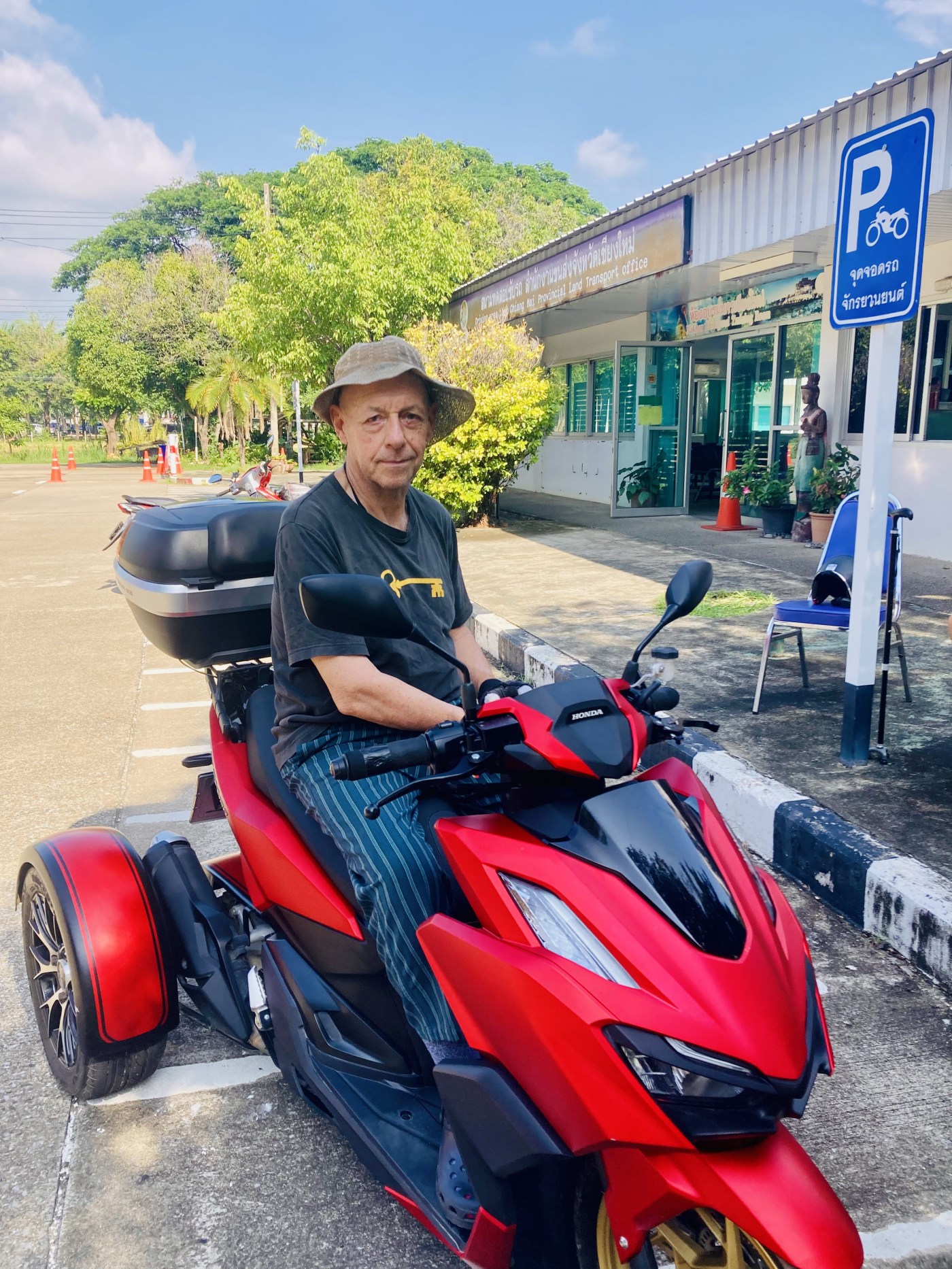
Now, four years following his stroke, Colin rides a motorbike again. It’s a trike and a far cry from the two-wheeled manual beast he drove all over Thailand, but every day he gets out there and does what he loves. He started with a four-wheeled electric, more a golf cart than a bike, but earlier this year upgraded to a three-wheeled Honda Click, hot off the showroom floor. When he finally got the hang of it, I watched him maneuver the bike with pride and purpose, pulling the throttle and bringing his dormant hand back to life, little by little. And I realize with awe that his reward is his therapy and his therapy his reward. His eyes, as shiny as the trike itself, simultaneously broke my heart and stitched it back together. His smile, slightly wilted on the right side, is like a child both surprised and humbled by his newfound ability to ride a bicycle. Or the man, proudly holding his newborn. I’m not sure it gets much better than that. During the past year I’ve known him, witnessing Colin’s milestones is like watching a handknit sweater come together over time, take shape, the colours finding each other in beautiful uniformity. It’s both momentous and simple, and a wispy sadness was present as I watched him roll down the bumpy road, away from me.
***
Bestselling author James Clear remarks on the incredible learning capacity of very young children. They spend the majority of their awake time playing on the edge of their ability, discovering the limits of their bodies and their physical environment, testing out schemas, assimilating and accommodating new information, developing theories of mind, failing, trying again. Every single day. Imagine spending 12+ hours so thoroughly engaged in learning a thing. It’s no wonder our brains grow more rapidly in the first seven years of life than at any other time.
In some ways, having a stroke later in life can present similar opportunities: To learn how to move our bodies with control and deftness. To take necessary risks. To expand the limits of our conditioned minds and consider new ideas. To actively explore what’s possible. Learning probably won’t happen at the same speed, but we’re well-equipped with decades of lived experience—a benefit children don’t have. The mind may warp our efforts much like overly-wet clay wobbles and collapses in the potter’s hands, but reaching beyond the mind we find inspiration. Inspiration drifts in from some other place, perhaps from each other, perhaps from spirit, who knows? We can use it alongside all we’ve learned to learn anew, to wake up inactive neurons and restore their charge. Knowing how a healthy hand moves is a good start for training it in a positive direction. We can challenge what we think we know and remain open to the unknown, to infinite possibilities. It’s evident that Colin is aware of this, and that he is—quite literally—in the driver’s seat of his own recovery. He accepts that while full recovery might never happen, it doesn’t hurt to try.
Driving the bike, two hours of physiotherapy, watching Alien Vs. Predator and listening to his favourite tunes, continuing with his trip reports, even if they only detail the events of his one hour circuit around the grounds of the rehab facility, and keeping his music files up to date take up most of the day. He often declines offers to socialize, saying he has too much to do. I need 26 hours a day, he tells me with a chuckle. I hold Colin’s life up to the light, next to mine, much like I’m comparing two negatives of a photograph and wonder how, in a single glimpse, his seems to have captured a certain kind of courage absent in mine. I have much to learn.


Leave a Reply