Slowly, I am letting things of the past go. For greater spaciousness, and the clarity inside it.
Paradigms shifting, core assumptions being challenged and chucked out, but with gratitude for getting me here.
My next few posts will be pieces I have written over the past few years, which only the girls in my original writing group have read.
These pieces, as all my writing, are my attachments. And I am fine with that for now—better than attachments to drugs or men! It recently came to mind that the way to “let go the story” is to tell it, share it, as I have actually always done.
But these next few pieces are little more, let’s say, honest. And perhaps not without consequences. So be it.
At a beautiful Night of Stories this past birthday weekend, my body froze when a speaker asked, “what do we write about when we are no longer in pain? When the motivation to write is not from grief or heartbreak?”
Oh. Yes. The question that has been sitting in my body for some time now, and which my body, by freezing, was attempting to keep safe and quiet. But there it was, all laid out. What the hell do I write about now? That will eventually become clear once I have made the space.
Clearing out the old to make room for the new.
I have a memoir, half written, and that will eventually become an actual start-to-finish thing out in the world. So, this is sort of like my practice run, sharing things that I was once afraid to admit to myself, let alone other people. And just the tender, hesitant beginnings of clearing out the junk drawer that holds beautiful mementos I no longer need.
Peeling attachments from our bodies is something of an icky, bewitching experience—simultaneously horrible and beautiful. There are usually some token scabby bits and a small or big scar left behind as the body heals itself.
Thank you for reading with care. Always free to comment. I do love hearing how my writing reaches—another attachment, perhaps 😉
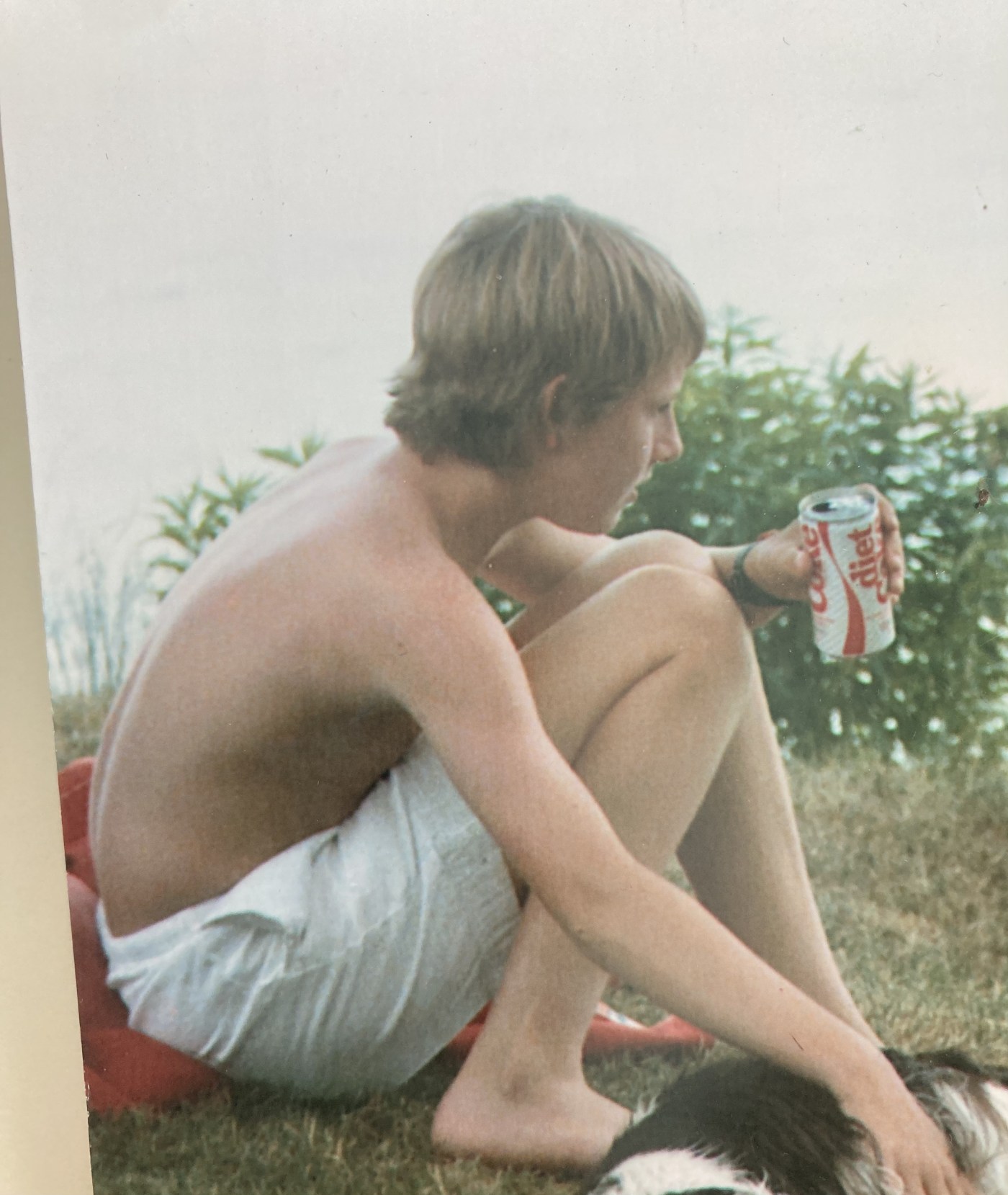
P.S. When I wrote this piece, I’d forgotten about the dog in the photo. It’s even more beautiful to me now.
The Photograph
“Love is the extremely difficult realization that something other than oneself is real.”
– Iris Murdoch
When you get divorced, people ask you a lot of pointless questions. They skirt around them, of course, behaving like Death is a bright pink elephant they’re scared to acknowledge. But when someone brave enough asks the obvious why and whose decision was it, you kind of want to applaud their courage to inquire about very private business.
I never had a satisfactory answer for anyone who asked me because my divorce made as little sense as my marriage did. I wanted security—protection from the world and reassurance that I belonged in it. A pair of warm feet under the covers next to mine, and someone who cared where I was every day. Then, I wanted freedom—no one asking where I’d been. To forget who I was to someone else. Decisions untainted by my past conditioning, and a bed all to myself. I didn’t realize until later that true freedom and security have nothing to do with marriage or divorce. I didn’t realize that my perspective of both was inaccurate—that freedom and security aren’t at opposite ends of a good life. I never told anyone about the tiny things that nicked my heart, like what happened to the photographs we’d spent gobs of money on saying I do, or what songs I avoided listening to. Nobody asked. Those things seem small, but anyone who has gone through a divorce knows how painful they are.
But it was years post divorce and around 127 plays of Harrison and Starr’s song Photograph before I realized that security, as most of us understand it, is an illusion and—to quote Janis Joplin—freedom’s just another word for nothing left to lose. I’d never be free outside a marriage if I believed freedom was something that could be obtained and lost, like a wedding ring. I’d never be secure in any relationship if security was the reason I was in it. So, marriage was a losing battle. But so too is being single, even as I yield to a new perspective of security and freedom. Because who we choose or don’t choose to be with is just another brick in the wall of our identity—how we see ourselves and how we wish to be seen. How we seek to fill. Rarely is it about the other person. Rarely is it about real love.
I returned to Canada a few years ago to visit my parents, a decade after my divorce. Monastic in their organization, my mom and dad had asked me to “review and update” the contents of the one box of belongings I had stored in their basement when I’d quit my marriage. I’d been avoiding it, knowing that it held mostly sentimental junk—the hardest stuff to throw out. But I’d forgotten that inside that box was another box bulging with the wedding photos we’d never put in an album. Why was that again?
Sat on the floor in their basement, I removed the shoebox lid and lifted the formidable stack of glossy photos. Hours ticked by as each photograph passed from my hands to the floor, one by one. Hundreds of photos of a hundred angles and expressions of me, of him, of us posed in silly, pretentious ways. Most were of me, shining and naive in my white princess frock. The bride is the star of the show after all. There were prints of the bridesmaids and groomsmen lined up like rows of white teeth smiling practiced smiles. Those photographs were the last relics of my marriage. We’d sold the long-stemmed Waterford and the four-bedroom house with its flagstone terrace—our first DIY home improvement project and “third thing”. I’d long since retired my heavy platinum rings.
Those things were easy to part with because they don’t have faces. They don’t capture moments of joy, hope, or love. They don’t activate mirror neurons the way familiar eyes and a lopsided smile can. They did not reflect my young, beaming face or show me the sadness in his brow.
Photographs can be cruel reminders of who we were when we thought we had life figured out.
Down to the final photograph in the cold quiet basement. It wasn’t of the wedding. It was faded and creased, square with rounded corners. Him as a young boy, sitting on a patch of grass, his upper body curved over skinny legs, one hand grasping an old-style can of Coke. His blonde hair picked up the sunlight. Just his profile had been captured, not even a blue eye. He might have been smiling. I reckon he was eight years old. I reckon he was perfect even then.
I felt like I’d just binged on Oreos. I was a tight, numb ball holding her breath, noticing the sugar film on her teeth and the walls of her mouth. I sat still, waiting for the shoe to drop, for the ground to crack open, for my inevitable disappearance. Nothing left to lose, wasn’t it?
Swift and certain, I moved with the desperation of an addict hiding her stash. I grabbed photographs by the handful, my shining face bending into caricature as I stuffed them into a black trash bag. One whole day erased from history. Subsequent years that suddenly made no sense. Some photographs I tore in strips. I didn’t look, I couldn’t. My breath came in short, needful sips, the kind we take when we can’t believe what we’re doing.
I knotted the top of the bag and stuffed it in a corner where it sat like black mold creeping up the wall. I scrubbed my hands and then ascended the stairs, opened the door, and stepped into the sparkling summer day. I slipped my hand into my pocket and ran my thumb across a crease, like braille, and over a rounded corner.
It was never about me.


Leave a Reply